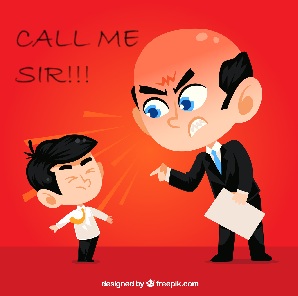
Back when I was a business skills trainer with an IT giant, one of the lines I used to repeat the most to my trainees was this – “Don’t call me ma’am.” It took quite a bit of effort with every batch to ensure that they stuck to “Radhika” and forgot “ma’am.” It is not just part of the corporate code but also a code followed in a number of places globally. However, many of my trainees, after joining their project locations, have got back to me saying how they had been penalized by immediate and higher-level managers for addressing them by their first names. And I used to feel bad for being the reason they were in trouble, even when neither I nor they did anything wrong.
This linking of addressing someone by their name to disrespect is pretty much a part of our culture I guess. I mean, as kids, we used to address everyone who was our parents’ age or close “uncle” and “aunty,” even when they had absolutely no relation to us. Anyone younger than that but older than us was “bhaiyya” or “didi” or their regional variants. And now, when we have kids of our own, we have passed on this norm to our kids too. As part of the social fabric of our country, this is followed without a question, and I will just let it be.
However, most of the time, this “age-related addressing” gets converted to “How dare you call me by my name!” irrespective of age or context. Once, I heard a resident of my building say angrily to another, who was the same age I think, “I am a central government employee. Stop calling me by my name, and show me some respect by at least adding ‘garu.’” Yes, these are people who see their own names as a sign of disrespect, dear lord! I wanted to laugh at this explicit demand for respect. The fact that he had to ask for it and even give a “worthy” reason for it kind of showed that he didn’t really deserve it.
But where do we put an end to this culture? Is it something that has to spill over to our workplace? At a place where everyone is supposed to be an equal, irrespective of their designations or status quo, why have we normalized the usage of titles like “sir,” “ma’am,” or even “ji”? Here, I plead guilty because I am someone who started a conversation with my to-be boss with an accidental “sir” and then stuck to it only because it would be awkward to change it later, and then, because of that, ended up calling the project lead, a co-founder of the organization, “ma’am”. However, these are people I’m sure wouldn’t have judged me if I addressed them by their names from the beginning. But why are there unofficial “punishments” for those who stick to the code and use first names to address superiors in many companies? Isn’t that simply a manifestation of a very fragile ego?
Of late, I have noticed this trend in very generic situations too, like talking about a celebrity. I was listening to an interview of a senior actress, who was talking about actresses who were senior to her and were at the top of their game at the time she started off as a lead actress. She spoke very respectfully about how great they were and how she used to be doubtful if she would live up to them someday. I saw nothing wrong in what she said. But a guy in the comments was highly offended and commented sarcastically, “Maybe these actresses are all her kunjamma’s (mom’s sister) daughters that she is using their names to talk about them.” And then I realized that I have been seeing these sorts of comments for a while now.
Anyone says “Mohanlal” or “Mammootty,” immediately, there would be at least some who correct it to “Lalettan” or “Mammookka.” An actor talks about senior actors from a previous generation using their names, and immediately, there would be comments branding that actor as arrogant (this rule mostly applies to actresses though, for some reason, thanks to our deep-rooted patriarchy, I guess). No matter how respectful one is in what they are speaking about, the absence of “sir” or “ma’am” is enough for all hell to break loose.
Especially when it comes to celebrities and public figures, I am totally at a loss about this backlash. I mean, I still say, “I am watching a Mohanlal movie,” or “Amitabh Bachchan was amazing in it.” Even those who are respected at a whole other level, like APJ Abdul Kalam, have us talking about them by their names. What is wrong with it, I ask! Of course, if I am personally talking to someone very important, I might also use “sir” or “ma’am” if I do not know them very well. But while I am speaking about them in general, I am not going to add a title to these stalwarts’ names to pander to some pseudo-respect-obsessed idiots.
The reason is simple. These are people whose names are reputed brands in themselves. Their names carry weight, and that identity is something that stands tall, representing their hard work and journey to being recognized at such a level. Why do I need to add a title to that when their names themselves command respect from every corner? I respect their names and the value they hold. So if I talk about how Thilakan, Oduvil Unnikrishnan, Innocent, Sukumari, or KPAC Lalitha are actors I adore, I am not disrespecting them by using their names without titles, I am giving their names due respect.
And those who aren’t “brands” and get offended about someone addressing you by your name – it’s your own name; learn to love it. Or maybe, change your name to “sir” or “ma’am.” Won’t that be an easier option instead of imposing stupid old-school respect rules?
Also published on Medium.
Leave a Reply